


“Not a cult. Not that.”
“What then?”
This flippant, sneering man. This stern woman in her ragged sheriff’s uniform. Their guns to hand.
“Support group.”
“Looks pretty culty to me. Chanting and bloodsigns and whatnot.”
Borderland: everything is on the border with something else. Nothing defined as anything for sure. Shifting definitions.
“A heterodox faith group with strong internal dynamics.”
“Yeah, figures you’d say that.”
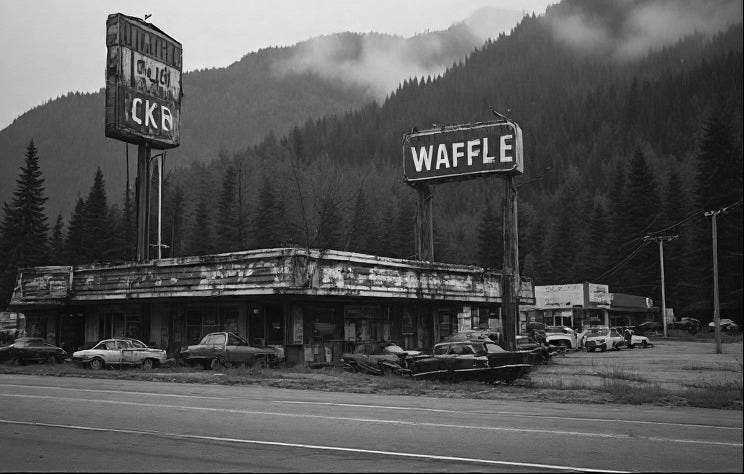
Words exchanged in this northernmost of places, this failed waffle franchise abutting the Canada frontier.
“Cult is just one of them terms people use when they don’t want to look at truth.”
“I’m looking, and I know the truth I’m seeing.”
Stale fry-oil, iron scent of drying blood. Giggles in dark corners. This small man, hard as only an underfed refugee can be, hard with inbred defiance of the abject.
“Sheriff, if that’s what you are, you have no idea what you’re seeing.”
“I know what I’m seeing.”
This situation is so ridiculous. But then so is everything else.
“So, Ms cop-lady, perhaps we could cut the shit and get to the point.”
“Point is, you have minors in here. Point is, we don’t trust you-all with them kids. Point is, we’re gonna take them away to be cared for.”
Hand on his revolver. In abeyance. When will the moment be, the switch-up?
“That so, ma’am? ‘We’? I don’t see no ‘we’. Just you here, all on your lonesome.”
“I’d say it is so. Don’t need no more’n me.”
That’s the moment. A step across that border into something else. Snap of fear, snap of distrust. And the game changes: someone reaches, someone aims and fires.
Shots blast hard within these thin walls, walls covered in occult devices scrawled in dried blood, dogeared notices with today’s special three pancakes for a dollar. Blast of the shots rebounds, echo slams into echo and nullifies.
The kids huddling behind the kitchen countertop start wailing but nobody hears them. The kids’ ears ring strong and they can’t even hear themselves. Void spots of nulled-out noise and these other spots where ballistic shockwaves redouble. The released energy in this small place big and chaotic.
Ten shots, twelve? Something like that, hard to say, what with the echo and re-echo.
At least the shooting’s stopped now. And energy resumes its slow crawl to nowhere.
Everybody dead, all the grown-ups? No, there’s one still alive, someone still moving.

About three years ago the Waffle House franchise operation collapsed, along with the entire society in which it nestled. All the complex arrangements, all those thin threads snapped at last.
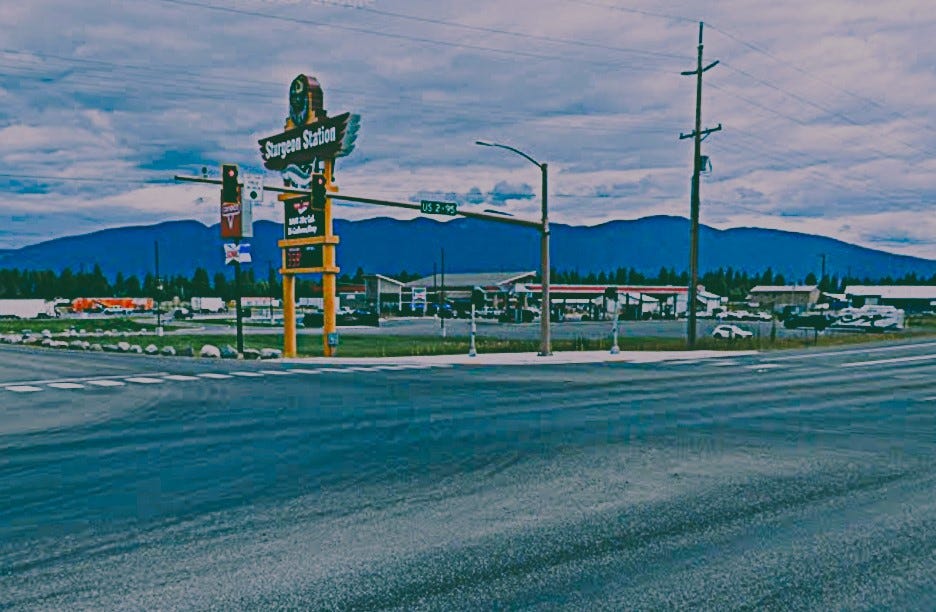
A mile outside Croggins Cross, the stripmall next to the Conoco station fell silent, like all places of commerce everywhere. All the retail locations accumulated weeds and vermin: Waffle House, Sturgeon Station, Burrley Animal Clinic, Han Fashion Imports Discount Boutique.
The Kollapse they called it, with a K for some reason. Krisis, then Kontamination, then Kollapse. In faraway cities millions died, refugees took to the roads, and first the wary countryfolk upgunned themselves, then they gunned down all those wandering undesirables.
The gas station was burned, a fine fierce conflagration for a new moon night that first May after our world fell apart. Black smoke and the dust which the strong winds from the midcountry bore along in roaring air dirtied all the pine needles on the trees, settled on the soft forest floor. Everything became slightly soiled. The stripmall joints became smudged wrecks.
But something redeemed this abandoned little space of the Waffle House: a freshwater creek running just behind it. Stragglers passed through and were gone to the north, but some few stayed to drink and to wash. There wasn’t much sweet clean water in the world, what with the Kontamination and the winddrifting smuts of soot.
While there was still some gas, Sheriff Val Martins would take her patrolcar and check round the Croggins Cross township, dropping in on the derelict stripmall. While there were food supplies still at the Church, she might take in refugee families for an overnight restock, on strict condition they’d move along in the morning. Sometimes she’d take an orphaned child in to a kindly neighbor. Neighbors were still sometimes kindly during those first few months.
She stuck to law-enforcement even though there were no more county paychecks and no more law to enforce. For a while her husband Dave supported her decision; he said the local community would be reassured to see her uniform, that comforting illusion of some order. Brought in venison and hogmeat from the woods to eat and to trade. But then Dave died of a strange and sudden throat tumor beginning of the second year. Hollow eyes poisoned with pain, tongue congested, mute appeal to her for the mercy of a bullet.
She stayed on. In theory the townsfolk chipped in for her keep, but in reality she was on her own. Hauling Dave’s body out to woods where he’d hunted. Alone, no neighbor to help or even attend the burial. Meanwhile the refugee population on the roads thinned out.
After the gas was gone, she’d patrol on horseback, mounted on Roddy her eight-year-old stallion, the horse hobbling and wheezing. Now when she found anyone at the stripmall, she’d move the people on. Once or twice there’d been gunplay, and she’d had to bury the bodies down behind the burned-out Conoco. Unhallowed ground, sure enough, but fuck, this here is the Kollapse.
A song played in her memory.
This ain’t no party, this ain’t no disco, this ain’t no foolin’ around
No more music in the world but what was strummed by townsfolk behind closed doors.
On the second year too she started noticing the first signs of occupation at the Waffle House. Signs of someone present, but not anybody she could see. Strange markings, drawn in blood on the walls. Too risky for her alone to check out. Strangers held rituals on full moons and new moons, and screams of slaughtered beasts rippled out across the valley to the township.
Shoulda burned the place down then and there. Not just Waffle House, the whole stripmall: raze it. But with no more gas or kerosene left, it would be a matter of collecting lumber and stacking it up in there. Sheriff Val determined to leave it until she could rustle up some kinda posse one day, come back in force. That day never came. Folks were in short supply to go out and do the work. Folks shut their doors to her.
The carious rot of the stripmall intensified. Gaps, weeds and stray critters.

One morning two years well in, all days now a smudged overcast, an ever-wintering bleary blur, her mount Roddy was too broken to carry her very far along. She led him back by his bridle out behind the woodshed and put a shotgun slug in his brain. Too weary to skin, dress and salt him now, Sheriff Val wandered out of town towards the stripmall and the Waffle place.
Hungry eyes gathered at the windows of neighboring houses. She knew there would be nothing left of Roddy by the time she got back. If she came back. She’d feared even to check Dave’s rough grave in the days after his burial.
Trudging in sooty slush amid greyfalling ash, it took her two hours to cover the distance to the stripmall. Silver breaks of ghostlight over the place, transcending its tawdriness. By now there was no doubt: the Waffle House was fully a desecrated space. Skulls of deer and badgers stood on poles around the mall, twigs woven into charms and talismans hung from the eaves of the corrugated roofing.
There were women fussing round a fire under the mall directory sign, bent sideways as windbreak and rainshelter. She stepped up to one of them, a young one, slicing wild radishes into a big pot, as other women backed away into the Waffle House.
“What’s cookin’?” she inquired, all friendly-like.
“Sacrilege soup,” said the woman without looking. Then, not recognizing the voice, she stared up into the eyes of Sheriff Val Martins.
“Ummm, my favorite,” said Val, and kicked over the pot, the soup and the grayish cuts of meat sizzling over the cookfire.
Inside the Waffle House their leader was by now well warned of her arrival. Women bundled the kids, not their own, into the rear kitchen and washup area. Some stayed; most took off through the backdoor and the gaps opening in the kitchen wall to light out beyond the creek.
There he was. Clear clear blue eyes in a leathery face, not old. Lean and wiry as a stoat. Mouth opened to show snaggy yellowed teeth, completing the stoatish likeness. He wore his auburn-tinged hair long in grease tresses and a beard, bare of moustache like a bible elder, revealing a disfigured hare lip with yet some charm. Red shirt with dangling fringes on the arms: old-timey gunfighter or hippy. In the waistband of his patched jeans was stuffed a fat revolver, a .44 magnum or the like.
This man was nominally ugly, parts not cohering into a physical harmony, his person raw and beast-touched. But it could be his animality, that untroubled poise and unconcern, it may have been his very roughness that gifted him this uncanny allure. Repulsed by him yet, Val Martins felt some obscure tug of fascination.
A stray thought, quickly pushed away: stay with these people, become one of his women, become tribemother to the brood.
“Name’s Olaf,” he said. “I run this place.”
“You run this cult, you mean.”
The shattered law which she pulls back together. And then the ridiculousness.

Smoke clears and the ears ring. Blastwaves of noise still blatter off the walls and collide at unknown angles. This short time of death was loud, louder than anyone had a right to expect.
The women, those sad bedraggled witches, are gone away. They might creep back or they may run deeper and deeper into the forests and never return again in human form.
But the children are still here, in the kitchen huddled under steeltopped counters, kids in their strangeness, in their wildness, with hands clamped tight over their ears. The one who seems to be the eldest, maybe seven, steps up to where she stands.
He casts a sideways look at Olaf dead in his blood, crimson staining dark through the scarlet of his fringy shirt, clear blue predator eyes fixed toward the ceiling. This older kid is unconcerned by any of this, and the others come out to gather round him. Not smiling, not sad; unlike any children Val has ever seen.
They’re odd, thinks Sheriff Val, otherworldly. Which seems about right as they’ve come to awareness in this other world. Not kids so much: offspring.
This elder child picks up Olaf’s revolver where it lies near his left hand. She speaks:
“How do you like the feel of that?”
“Warm. Still warm”
His breath steams within the murk. Now silvery glints break through cracks in the roof, pour in through the cracked skylight.
“I’d say you-all need something warm like that.”
“We been cold here.”
His smile sharp as a weasel, the dead man’s estranged brute bearing writ small. Heavy revolver cuddled to his chest for warmth.
“I’m gonna take you-all somewhere warm and safe, okay?”
“Ummm... okay.”
A flat-out lie. Her township is filled with betrayal and denial, but maybe...
“All I want you kids to do is just one thing for me, okay?”
“What thing?”
Holsters her own pistol, reaches out to the child for the heavy revolver.
“Call me Mommy.”
“Mommy.”
The child holding the great gun looks round at his siblings and they all nod together. Then make a strange sign, wiggling their thumb over their face like Catholics do. But different.
“Mommy.”
“Yes, your Mommy.”
Slowly they process out of the Waffle House into the broken silver daylight, making their way to their new home, their new world. A restitution of law.
Written in response to the original SUM FLUX Waffle House open call
Apocalyptic. Feels like an prologue before an epic journey
TALKING HEADS